

Alana Coates is a time-based media conservator with a background in software product management, now focused on the preservation of obsolete and born-digital media. She is finishing her MSc in Conservation of Contemporary Art and Media at UCL and recently completed a research fellowship at the V&A. She currently works on an audio preservation project for early sound recordings.
What are we preserving? Why now?
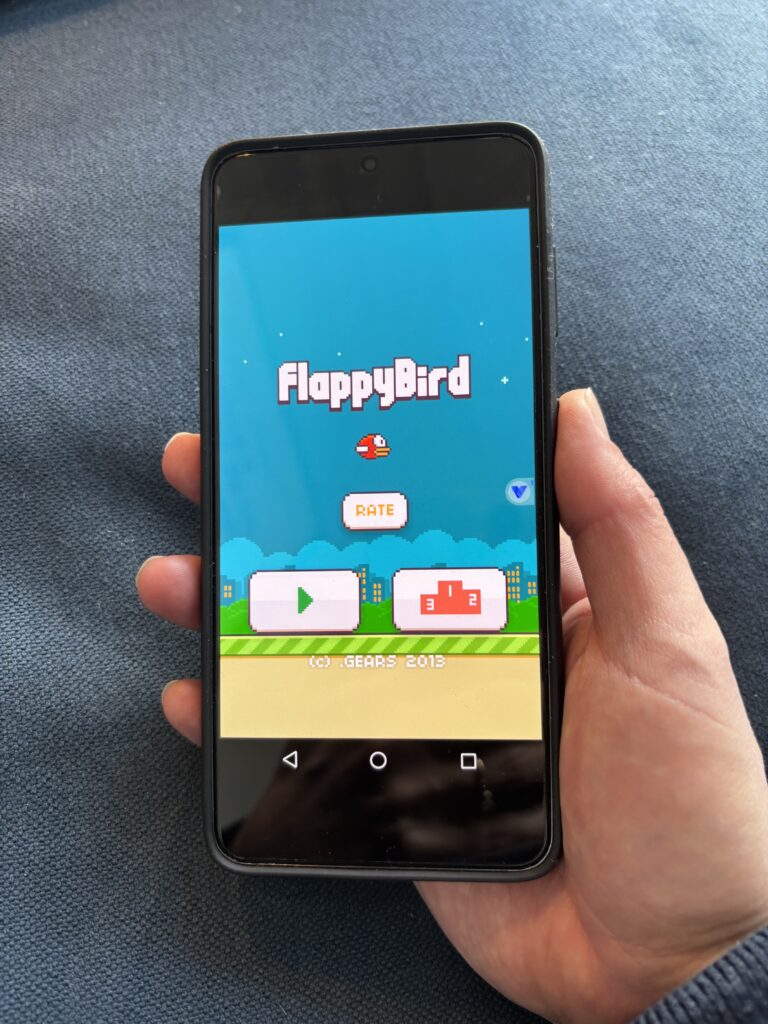
Flappy Bird was built for 32-bit phones. By 2021 Google had stopped serving 32-bit-only apps to modern phones, so today Flappy Bird simply won’t install on a current handset. The game didn’t just decay on its own, it continues to be stored safely on the V&A’s servers. Instead it was the ground beneath that moved.
My project set out to test how you actually keep a work like this playable. If a curator wanted to display it, could they? So the project started off as a condition check. But before testing anything, I had to decide what we’re preserving. A game is not just its code. In conservation we talk about significant properties, the things a work has to keep in order to still be itself. Its creator Dong Nguyen designed it for someone holding a train strap with one hand and tapping with the other. Without the touchscreen it’s a different version of the game. And given that the V&A specifically collected this work as an example of a viral mobile game, the tap matters and is a property worth keeping. The phone in the hand also matters, and so do the slot-machine chimes and thuds. Its creator put a lot of thought into creating an addictive game and it’s those properties that made it such a big success. What doesn’t matter is the exact phone model or the size of the screen, because it was built to run on almost anything and it scales perfectly to fit any size screen.
File analysis
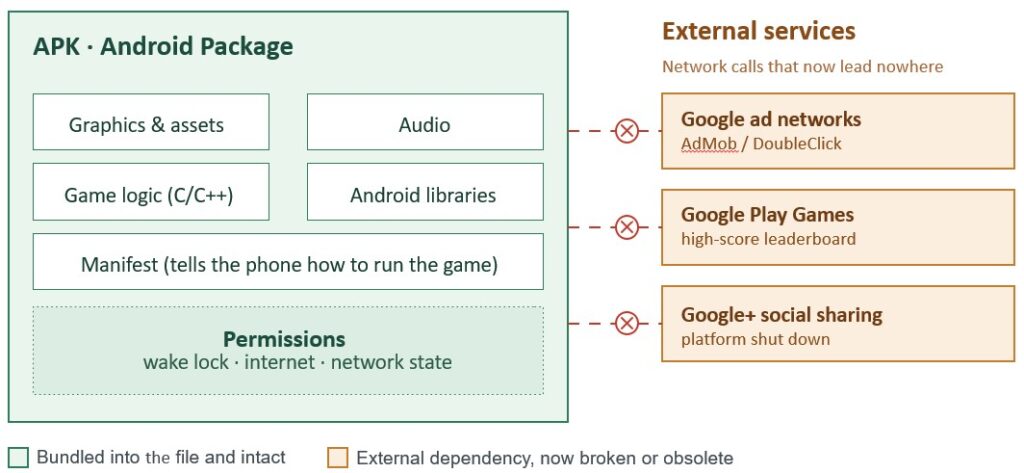
I opened up the files in order to understand how the game works. The V&A holds Flappy Bird as an APK, an Android Package. Picture a sealed box carrying everything the phone needs to run the game. To open the APK I used a tool called APK Analyzer, which is part of the Android development studio but can be downloaded separately as well. It’s very useful for this kind of analysis because you can run Terminal commands on the files to extract specific information.
In the above chart, everything in green is bundled into the file and intact: the graphics, the sound, the game logic, the libraries, and a manifest that tells the phone how to behave. It asks for only three permissions, with no camera or microphone. It’s a snapshot of how mobile games were built in 2013, right down to the C++ game logic and the ad networks baked in. A little time capsule.
This is good news for conservation. Android packages are open. You can extract them, archive them, and reinstall them on many devices without going through a store. An iOS app is much harder, locked into Apple’s closed ecosystem.
The trouble is on the amber side. Flappy Bird reaches out to services that no longer exist: Google’s ad networks, the Play Games leaderboard, and a sharing link to Google+ (remember that??). At this stage it was unclear if any of those broken calls would stop gameplay, so the next step was to run it.
Install on legacy phones
I looked at a few different options for preserving the game in playable form. The first is the obvious one: run it on the hardware it was born on. Turns out this is currently still very easy, there are lots of 32-bit phones still kicking around. I bought a 2014 Motorola Moto E, the model the V&A displayed it on, for twelve pounds. I installed the file directly and it worked. This is the most authentic version we can offer today.
There’s a catch on the home screen. Tap the leaderboard and you hit an error, obviously because the server it calls was switched off in 2014. The play is untouched, but that dead button is confusing, and a conservator probably could disable it. The deeper issue is time. It won’t always be so easy to get a 32-bit phone. So this is the best way to have the original flappy bird experience today, but that window of time will close.
Emulation and virtualisation
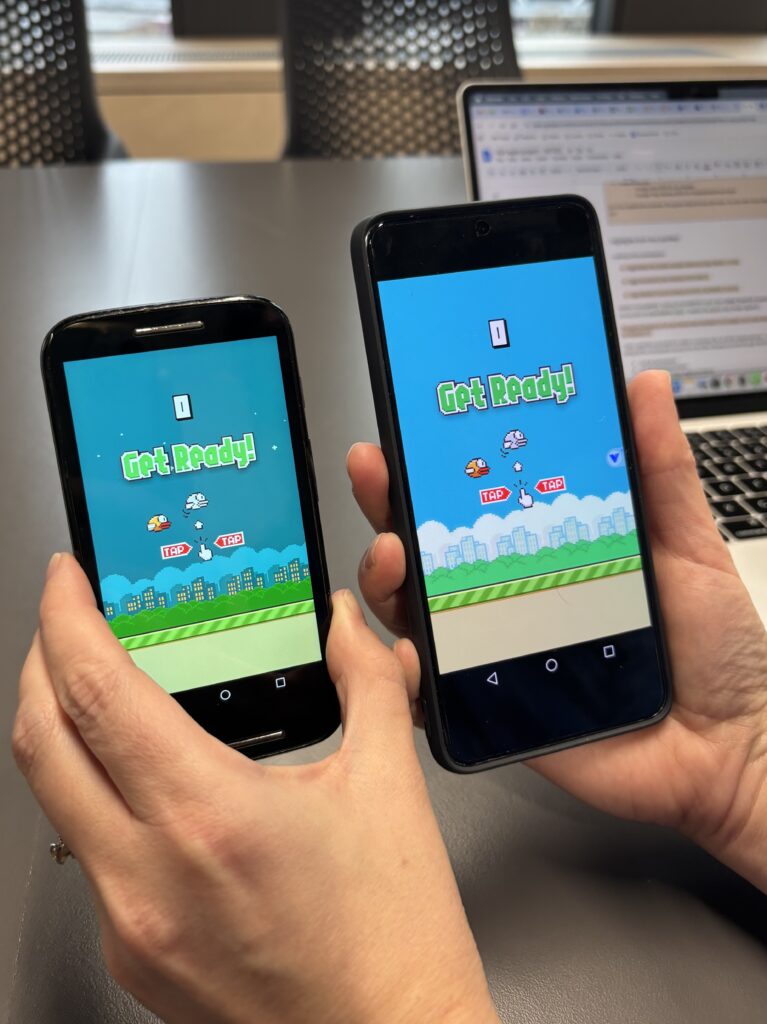
As mentioned, one of the significant properties of the V&A object is that it should ideally be played on a phone, because that’s why it was collected. So when that hardware runs out, can we just move to a modern phone? Not directly, the 32-bit file is refused. You need a layer in between, and there are two kinds. An emulator rebuilds the old hardware from scratch: thorough, but slow, because the phone is imitating a different machine. I had high hopes but unfortunately the open-source emulator I tried kept crashing so this was not a feasible pathway. A virtual Android app is lighter. It runs an older version of Android directly on the modern phone’s own chip, so it’s fast. There are many of these apps available in the app store, but one called vPhoneOS was particularly effective. The screen is much bigger and brighter than on the Motorola, but the game was never tied to one display, so that’s acceptable. However, conservators tend to prefer open source tools for transparency and these apps are black boxes. I can’t document what’s inside them, and if the developer walks away, our access goes too.
Migration
Another option to preserve a mobile game would be to migrate the game, rewriting it to run natively on modern systems. This is the hardest pathway, and it was out of scope for this project, because the museum holds the APK but not the creator’s source code. Without the source, migration means reverse-engineering the game almost from scratch – which is possible, although it’s a significant intervention. And it wasn’t necessary to go to this length today, because it’s still possible to obtain 32-bit phones easily. Meanwhile the community has effectively done this already, with hundreds of open clones out there.
Documenting it while we still can
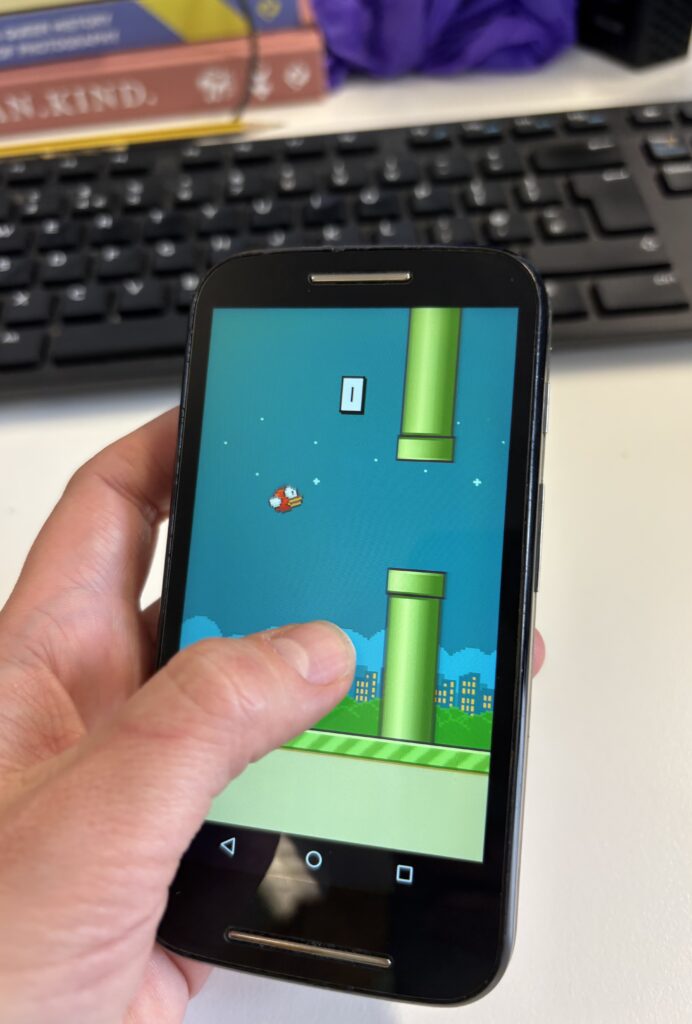
When the V&A first showed Flappy Bird in 2014, it displayed not the playable app but a video of the game in motion, so a record of how it looked is already in the collection. What was missing was how it was physically played. That sounds almost too obvious to record, but I don’t take it for granted that someone fifty years from now will know how a mobile phone worked, or how you held and tapped it. So I filmed it held in one hand, thumb on the glass, the way Nguyen intended. If every other pathway fails, that record is how the work survives. So documentation is also a very important form of preservation.
So where does all this land? We’ve seen that mobile games are fragile in a way a chair or a painting isn’t. They don’t visibly decay; it’s the ecosystem around them that falls apart. Preserving the code isn’t enough on its own, because the external services it leans on fail too. No single pathway protects against that, and keeping an app alive is therefore an ongoing activity, not a one-off fix.
But here is the hopeful part. It’s 2026, the bird still flies, and it’s still very good fun. The game is obsolete but there are ways around that. Between period hardware, virtual phones, a devoted community, and careful documentation, Flappy Bird lives on.
Leave a Reply